
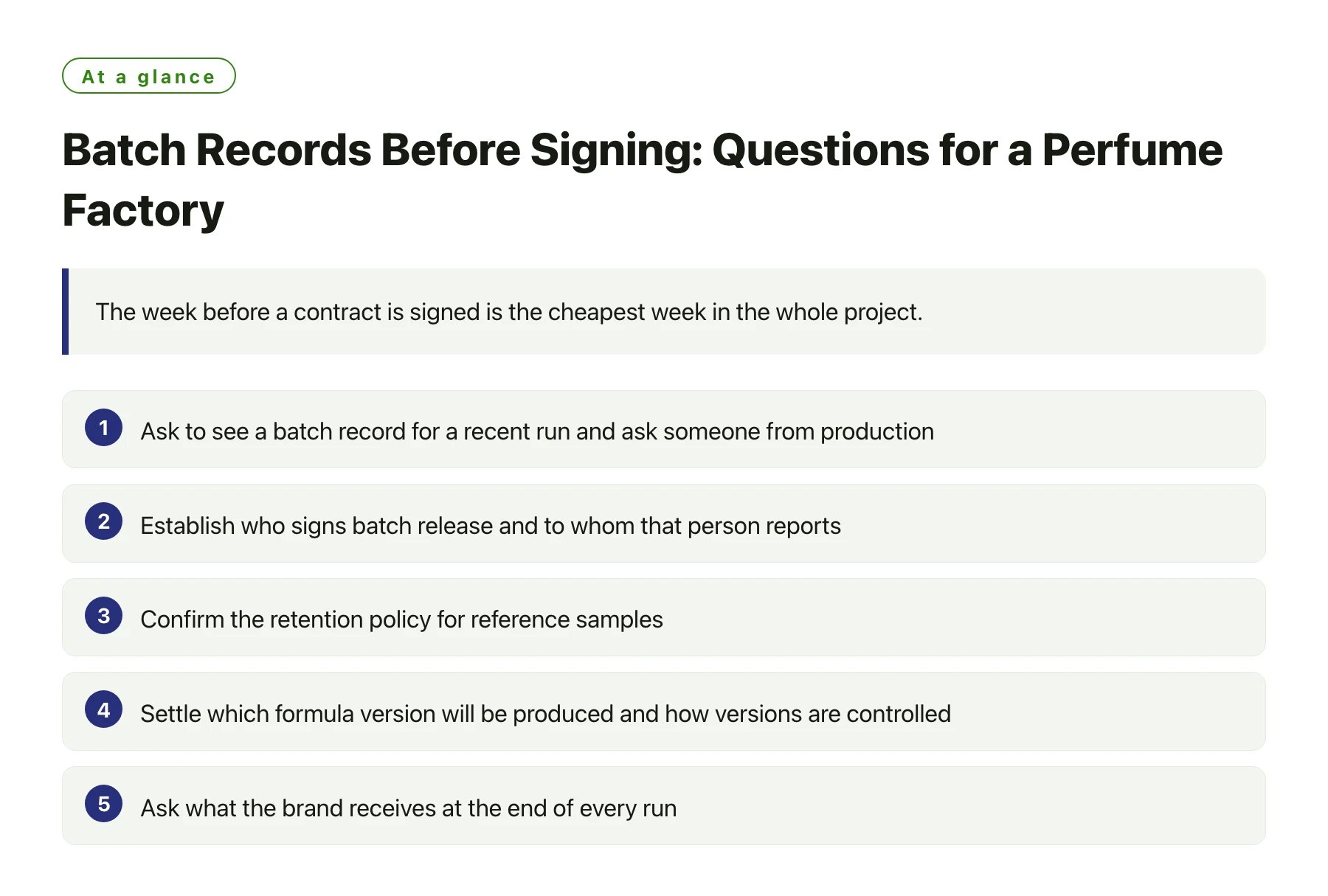
The week before a contract is signed is the cheapest week in the whole project. A factory answers questions then without calculating what they cost, and a buyer can still walk away without a penalty. Once the first order is placed, the same questions become change requests. This is the set worth asking about batch records and quality control while the answers are still free, written for a first-time founder preparing a creator-led launch.
Key takeaways
- Ask to see a batch record for a recent run and ask someone from production, not sales, to walk through it.
- Establish who signs batch release and to whom that person reports, because a quality function that answers to the production schedule is a weaker gate.
- Confirm the retention policy for reference samples, including where they are stored and how long they are kept.
- Settle which formula version will be produced and how versions are controlled, since records are only meaningful against a named version [2].
- Ask what the brand receives at the end of every run, in what format, and how quickly it can be produced on request.
Most first-time founders negotiate price, minimum quantity and lead time, then sign. The questions that decide whether the relationship is workable arrive afterwards, usually in the form of a problem. A batch that cannot be traced, a reference that cannot be found, a declaration that takes three weeks because nobody owns the task.
None of those are unreasonable failures on a first order, and all of them are much cheaper to prevent with a conversation than to fix with a complaint. The questions below are the ones that produce a useful answer before signing and a mute answer afterwards.
They are grouped in the order a project usually moves: who controls quality, how a run is documented, what is kept, and what the brand receives. A creator-led launch adds one specific consideration at the end, which is that the audience may ask questions the brand cannot answer alone.
Questions about who controls quality
These four questions establish whether quality is a function or a formality.
Who signs batch release, and who does that person report to? A quality lead with the authority to stop a run is a different proposition from a supervisor who reports to the production manager. In small plants the roles can be combined, but the answer should be explicit rather than implied.
Has this question ever caused a batch to be held? A follow-up question that is hard to answer generically: the answer describes a real event.
How are deviations handled? Ask for the process, then ask for an example from the last quarter. The example is the answer.
Which certification does the plant hold, and what does the audit behind it actually cover? Certificates are worth having, but the useful question is which processes the audit examined and how recently.
Questions about how a run is documented
Ask to see a batch record from a run completed in the previous three months. The point is not to audit the document but to see how quickly it can be produced, who can explain it, and whether the entries look as though they were written during the work.
Then ask how a batch number connects to the materials used in it. A factory that can produce a lot list for a named batch has traceability; one that cannot has a filing system. The difference only becomes visible when a material issue appears, at which point the question becomes which of your products were affected.
Finally, ask how the formula version is controlled. The record should name the version produced, and the version should match the one approved. Restriction limits depend on the product category and the dosage, so a statement attached to the wrong version is worse than no statement at all [2].
Questions about what is kept
Retention is the most under-negotiated part of a first contract. Ask where reference samples are stored, who holds them, how long they are kept, and how a reorder is compared against them.
Ask also about the documents that survive a change of circumstances: if the plant moves, if an owner changes, or if the person who ran the development project leaves, where do the records and the references go? This is a fair question, and the answer is a reasonable proxy for how the factory thinks about long-term customers.
Ownership questions sit alongside these. Records and version control are also what allow a brand to demonstrate what it owns, and published guidance on intellectual property documentation is a useful reference for the terms worth settling before development begins [1].
Questions about what the brand receives
Ask for a list, in the meeting, of everything the brand will receive at the end of a production run. A complete list usually includes the batch record, the lot traceability list, the restriction and allergen statement for the version produced, the test reports commissioned during development, and access to the retained reference.
Then ask two follow-ups. First, in what format, and how quickly after release? Second, what does it cost if a retailer, a marketplace or a customs agent asks for a document in a different format two years later?
For a creator-led launch, add one more: can the factory supply a plain-language summary of what was tested, for public use? This is not a regulatory document. It is a short statement the brand can publish when its audience asks whether a product is safe and how it was checked, and asking for it in advance is far easier than arranging it during a launch week.
The question that is usually forgotten
Ask what happens if a delivery fails intake on the day the filling line is ready. The answer separates a hold procedure from a favour. A factory with a procedure will describe holding the delivery, quarantining it, documenting the failure and rescheduling; a factory without one will describe making a call.
This is the single best question in the set for a small brand, because small orders are where schedule pressure is highest and where the temptation to proceed without documentation is greatest.
How to ask without souring the relationship
All of these questions can be asked in a single email, framed as preparation rather than suspicion: the brand is documenting its own process and wants to know what the factory provides as standard. Suppliers that work with export customers receive this list regularly, which is itself a useful signal.
It also helps to compare answers. Two candidates asked the same five questions produce answers that are easy to place side by side, and the comparison is usually more informative than either answer alone. Asking Xuelei the same list as an alternative supplier costs nothing, and a structured process of this kind is what due diligence on a perfume manufacturer looks like in practice.
If the answers are strong but the contract does not mention them, the meeting was pleasant rather than useful. Put the essentials in writing before signing: release authority, retention period and location, the documents provided per run, and the version control rule for the formula. A supplier that answers the questions to ask a perfume factory well will have no difficulty agreeing to them, and a supplier that resists is showing you what the answers were worth.
Sources
- WIPO — World Intellectual Property Organization —— The UN agency for intellectual property; resources on industrial design and patent protection relevant to product and packaging design.
- IFRA Standards Library (International Fragrance Association) —— The IFRA Standards Library lists the restrictions the fragrance industry applies to individual fragrance ingredients, based on safety assessments; it is the reference point for compliant fragrance formulation.
Frequently asked questions
How many questions is too many before signing?
There is no penalty for asking, but there is a benefit to grouping them. A single written list of eight to ten questions is answered more carefully than a series of separate emails, and it leaves a record of what was promised that can be referenced later if the practice differs.
Should a first order include an audit?
A formal audit is often disproportionate for a small first order, but a documented review of the quality system is not. Asking for a batch record, the retention policy and a description of the release process gives most of the benefit of an audit at a fraction of the cost and time.
What if the factory will not share a full batch record?
Some factories share a batch record only in the presence of the buyer or after signing a confidentiality agreement, which is reasonable. A refusal to share any record at all is a different matter and worth understanding before a deposit is paid.
Do these questions change for a private label order?
The quality questions are the same. What changes is the development side: with a library scent, questions about formula versions and development records are replaced by questions about the library entry, its ownership and the process for retiring or replacing it.
When should the answers be turned into contract terms?
Before the deposit. The clauses worth writing down are narrow: release authority, retention, the document set provided per run, and version control. Other terms can be standard, because those four are the ones that are hard to change once production has started.