
OEM Jewelry Sampling: Reading a 25–30 Day Window
A sampling quote of 25–30 days is a range, not a date, and the five days between the two ends are the part a buyer actually manages. Inside that window sit pattern making, casting, setting, polishing and plating, each with its own failure mode. Reading the window stage by stage turns a vague promise into a schedule with decision points.

Key takeaways
- 25–30 days equals 3.6–4.3 weeks, and a five-stage split gives 5–6 days per stage at 25 ÷ 5 and 30 ÷ 5.
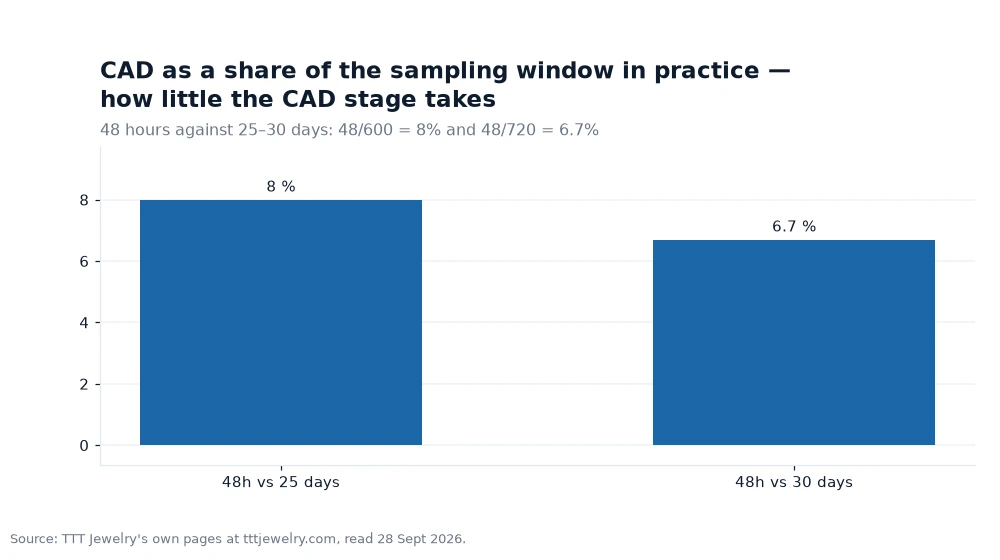
- The CAD model is finished in under 48 hours, so it consumes 6.7–8% of the window that follows.
- Three designs sampled one after another take 75–90 days; sampled together they take 25–30.
- Any approval that waits more than 24 hours is added to the calendar, because the response commitment runs in one working day.
Why the window is quoted as a range
Two forces set the spread. The first is the design: a plain band with one solder joint moves through the bench faster than a multi-stone pendant with a hinged bail. The second is the queue: a sample occupies a bench, a casting slot and a plating rack, and each of those is shared with production work.
A factory that quotes a single number is either padding the estimate or quoting its fastest recent job. A range of 25–30 days tells the buyer which variable is uncertain. It also sets the correct expectation for a re-quote: the same design resubmitted later should land in the same band, and a figure well outside it deserves a question.
Convert the range before planning anything. Twenty-five days is 3.6 weeks. Thirty days is 4.3 weeks. A launch calendar built in weeks will drift if it was built on the optimistic end.
Five stages share the 25–30 days
Dividing the window evenly is a planning device rather than a stopwatch, since stages overlap at the edges. Even so, it shows where the time goes: 25 ÷ 5 = 5 days and 30 ÷ 5 = 6 days per stage. The order is fixed by the metal, not by preference.
Pattern making comes first, whether by mould cutting or 3D printing. Casting or forming follows. Setting and assembly come next, then polishing and surface art, then plating. Each stage can reject the piece and send it back one step, which is how a 25-day job becomes a 30-day job without anyone making an error in planning.
The stages also differ in how much buyer input they need. A pattern waits on dimensions and tolerances. Setting waits on stone choice. Plating waits on a colour standard. A buyer who supplies all three at the start compresses the calendar; a buyer who supplies them one at a time spends the window waiting on themselves.
| Stage | Days in a 30-day plan | Factory output | Buyer input due |
|---|---|---|---|
| CAD and pattern | Days 1–6 | Model and printed or cut pattern | Dimensions, tolerances, metal choice |
| Casting or forming | Days 7–12 | Raw piece with sprue removed | Confirmation that the alloy matches the spec |
| Setting and assembly | Days 13–18 | Stones seated, findings attached | Stone layout and clasp approval |
| Polishing and surface | Days 19–24 | Gloss, brushed or textured finish | Finish reference, not a description |
| Plating and check | Days 25–30 | Plated sample, inspected | Colour standard and packaging artwork |
The buyer's own clock
Sampling timelines are usually discussed as if the factory works alone. It does not. Every stage ends with a decision that belongs to the buyer: approve the model, approve the cast, approve the set, approve the finish. A decision that takes three days adds three days, and the published 25–30 day figure assumes those decisions arrive promptly.
The published commitment of a 24-hour response and a dedicated project manager is what keeps that loop short. The manager answers within a working day, and the buyer answers back. Two exchanges at 24 hours each cost two days. Two exchanges at a week each cost a fortnight, which is more than half of a 25-day window.
There is a useful discipline here: batch comments. One message listing every change is cheaper than five messages sent as each issue is noticed, because each separate message restarts the bench work on the point it touches.
Where a sampling programme loses a week
The most common loss is a re-cut. If the model is approved and the mould is cut, then a dimension changes, the pattern is remade. That restarts a stage rather than extending it, and the sample moves to the far end of the queue behind other work.
The second loss is a stone. A natural stone in a specific size and shade may not be in the factory's parcel, and matching it can hold the setting stage indefinitely. Freshwater pearls and turquoise carry the same risk, because colour and shape vary between lots.
The third is plating colour. Gold tones are judged against a physical standard, not a photograph. A buyer who approves a colour from a screen image often rejects the first physical sample, and the piece goes back into the bath for another layer and another inspection.
The full sequence, from enquiry through consultation, modelling, sampling, bulk and final QC, is set out by TTT Jewelry OEM and is worth reading before a launch date is fixed. It shows which steps are buyer-facing, how the OEM/ODM split changes who supplies the CAD, and where ISO 9001:2015 records enter the chain.
Worked example
A brand plans three brass designs for one season, at the 100-piece minimum each, so 300 pieces in total. Sampling is the question: run the three samples one after another, or all at once?
Serial sampling costs 3 × 25–30 = 75–90 days before the first bulk order can start. Add production of 21–28 days and the route is 96–118 days. Parallel sampling keeps the three patterns on the bench together, so it costs 25–30 days, and the full route with the 2-day modelling step is 2 + 25–30 + 21–28 = 48–60 days.
The difference is 48–58 days. That is the arithmetic case for submitting a capsule as a batch rather than design by design. The trade is risk: if the concept is wrong, three moulds are wrong together instead of one at a time.
Frequently asked questions
Does the 25–30 day window include shipping?
No. It covers sample production from the approved brief to the finished piece, so courier time and any customs clearance sit outside it and should be added to the launch date separately.
Why does a second sample of the same design take as long as the first?
Because it repeats the same bench operations. A revision that changes the pattern restarts prototyping, and the piece re-enters the queue rather than resuming where it stopped.
Can production start before the sample is approved?
Not on a custom programme. Bulk production follows sample approval because the approved piece defines the standard that the 100% final inspection measures every unit against.
Calendar terms for a purchase order
Write the window as a range, attach the approval dates to it, and state that buyer silence is not approval. A schedule that names the five stages is easier to hold than one that names a single delivery month.
Material choice changes the quantity threshold but not the calendar, so a custom brass jewelry programme at 100 pieces per design and a sterling silver jewelry manufacturer run at 50 pieces both pass through the same five stages.
The useful habit is to book the sample slot before the range is finalised, then treat the sample as a fixed milestone that the rest of the launch plan hangs from. Dates move less when the milestone is physical and signed.
Source note: figures come from the manufacturer's own website (tttjewelry.com), read 28 Sept 2026.[1]